
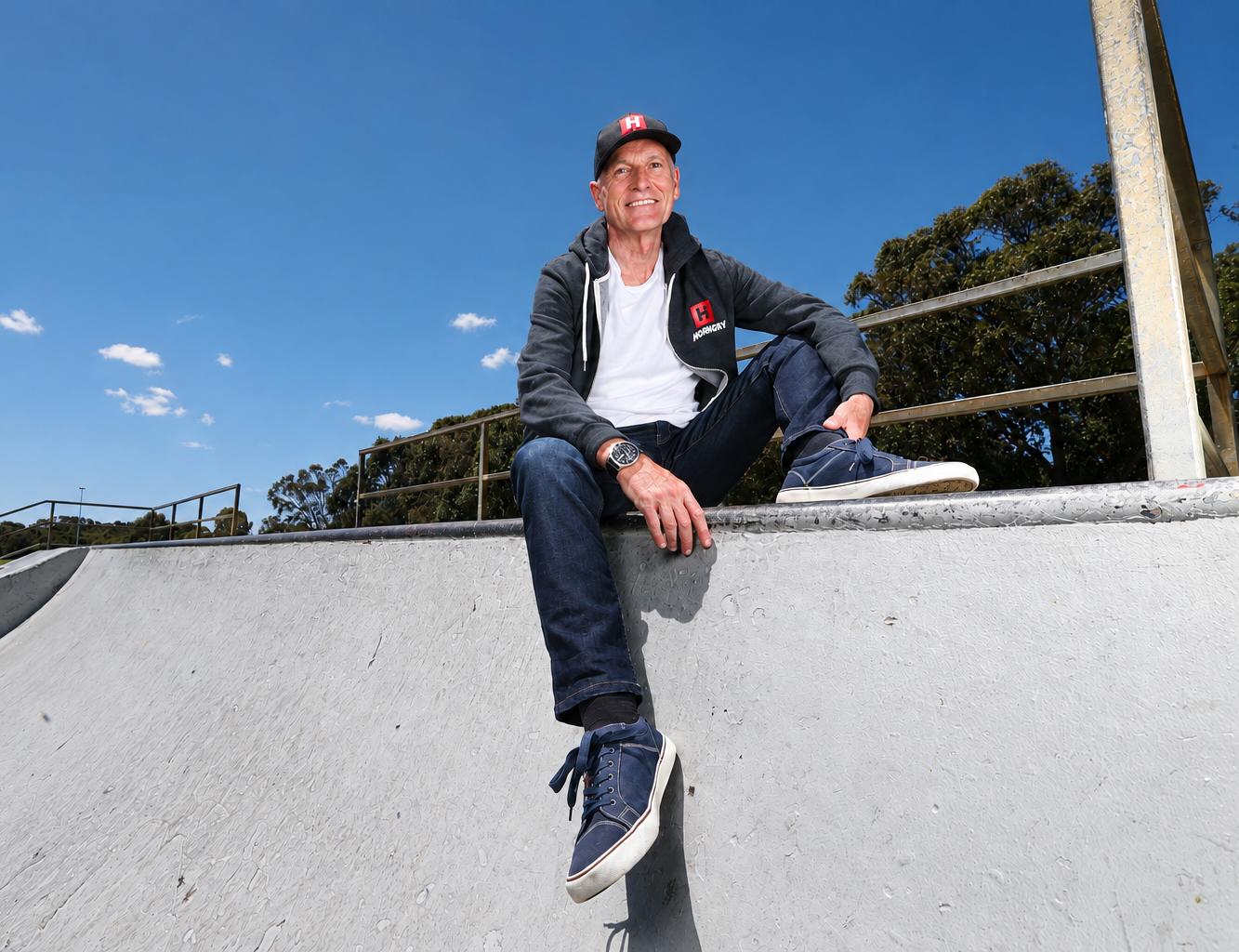
Chapter One
Before the park.
The care system isn't one thing. It's a run of places that are never really home. Bedrooms that belong to someone else. Faces that change before you've worked out who to trust. You carry what you can and leave the rest. Again and again, until leaving is the only thing you're any good at.
I moved a lot. New schools, new postcodes, new unwritten rules to decode before someone decided I didn't fit. You build up an instinct for reading a room, working out who's safe, figuring out what version of yourself will pass. It looks like social anxiety. It's a survival skill. You learn to take up less space.
What you don't learn is how to belong. Belonging needs roots. Roots need staying. Staying was never on the cards.
"The thing about never belonging anywhere is that you get very good at recognising the feeling when you finally find it."
I'm not telling you any of this for sympathy. I'm telling you because it's the reason HORNGRY exists. Every call we've made runs back to what it feels like to be on the outside. What it costs you. What it means when someone finally opens a door.
Chapter Two
The park didn't ask.
The local skatepark was the first place that never asked me where I came from. Didn't matter what school I went to, who my parents were, what postcode I slept in, or whether I was staying. The concrete didn't care. The riders didn't either. You turned up. You rode. That was enough.
When you're learning to skate, ride a BMX, or surf a break, the person next to you has more than likely already failed at exactly what you're failing at. They've eaten the concrete. They've swallowed half of the ocean. They've swallowed piles of snow. They've planted their faces in deep and dirty mud from bike falls. They may have lost their front teeth. They know what that landing feels like. But, instead of using that to keep you out, they use it to help you improve and get better. That's the power of grass roots sport.
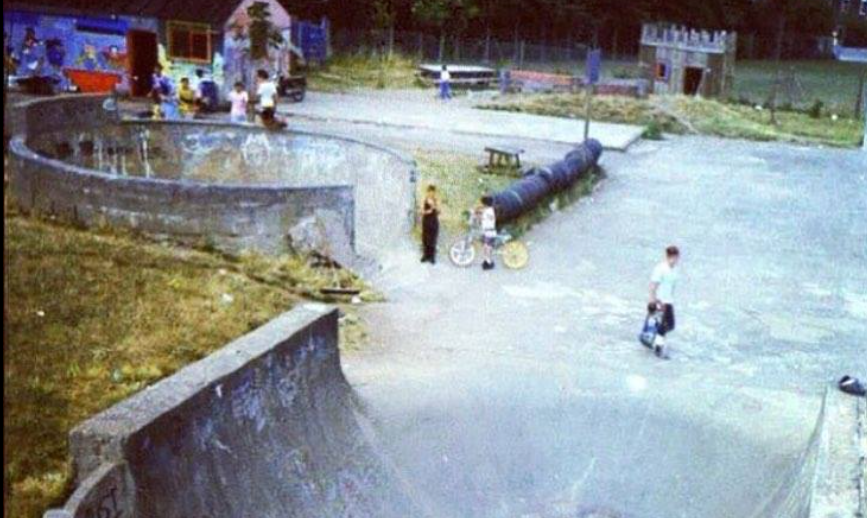
Local skatepark, early years
As for me, I wasn't a standout on a board or on a bike. Nobody was scouting me for sponsorship. In my mind at the time, I was good enough to be there, and being there was enough. First time in my life I had people who shared my thing. I had a reason to show up as often as I could that had nothing to do with obligation and everything to do with wanting to.
That feeling, that mix of physical challenge, community and belonging, is what I've spent the rest of my life trying to put within reach of everyone. Not only the kids who stumble onto it by accident the way I did. All of them.
500M+
People who do action sports worldwide
0
Global platforms built for all of them, until now
1
Question that started it: why doesn't this exist yet?
Chapter Three
"Everybody saw it. Nobody fixed it."
As I got older I started to see a pattern that made me quietly furious. Kids at the park, some of the most talented riders I'd ever seen, were going nowhere. Not because they weren't good enough. Because the system had decided they weren't visible enough.
Sponsorships went to riders who already had followings. Followings went to riders who already had connections. Connections went to riders who already had access to the right coaches, the right comps, the right circles. And access went to riders who already had money.
"The talent was everywhere. The opportunity wasn't. That gap is the exact shape of HORNGRY."
Care system kids. Working class kids. Kids in the wrong postcode, with the wrong accent. Kids in countries where action sports existed but support structures didn't. I watched them ride with everything they had, with nobody watching who could actually do anything about it. Then I watched them stop. Not because they wanted to. Because the life they'd been handed didn't leave room for chasing something nobody was going to reward them for.
That's a specific injustice and it's a preventable one. The fact that nobody in a position to fix it had bothered is the thing I couldn't get past.
Chapter Four
Angry enough to build.
HORNGRY didn't start as a business plan. It started as a question I kept asking. Why doesn't this exist? A global home for everyday riders. Not the elite, not the sponsored, not the people who'd already made it. The other 500 million. The ones who showed up every day for the love of it, with no expectation of being recognised and no infrastructure behind them. What was obvious to me was that we could connect to anybody in the world and gain masses of connections, but loneliness and isolation was, and still is, increasing at an alarming rate. Why were we not using all this technology to unite people and bring communities together?
I worked out the answer eventually. It wasn't profitable enough for the people who could have built it. The industry decided the audience worth chasing was the aspirational consumer. The person who wanted to look like a rider more than they wanted to ride. Serving actual riders in all their messy, scattered reality was harder money and slower money.
So nobody did it. And the space hundreds of millions of people needed stayed empty.
Chapter Five
Forty years before HORNGRY
I didn't build HORNGRY as a kid straight out of the care system. I left school with a handful of qualifications and spent four years as a furniture removals man. Then I became an area salesman for an electronics company, and while I was doing that I studied business management, finance and executive leadership on the side. That led to a role with one of the world's leading business consulting and leadership development companies.
At 35 I set up my own advisory business, helping entrepreneurs start, grow and build their companies. I also built a mergers and acquisitions advisory business, working with over 200 companies across the UK, Australia and the US on acquiring competitors. Along the way I started and invested in my own marketing agencies, and later sold them.
In my late fifties, I made the decision to leave the corporate world behind and put everything I'd learned into something that actually mattered to me: getting people, especially the ones the system overlooks, off screens and into sport, into community, into belonging. That's when HORNGRY was born.
The Beginning
The Question
Why is there no global home for the everyday rider? The frustration becomes a decision.
The Foundation
HORNGRY is Born
Brand registered. Trademarks registered across UK, US, EU, China and Australia.
The Model
Three Pillars Established
The APP/Platform. The Gear. The Events. One ecosystem, built so each part feeds the others and the community sits in the middle.
The Reach
Global Expansion
Operations across the UK and Australia. 40+ domains secured. A community growing across Street, Surf, Dirt, Snow and Sky.
Now
The Home Is Open
The door we never had. Built for the uninvited. Open to anyone who shows up.
Open to anyone who would show up, we ran local community events at skateparks across Western Australia, Manchester and London to see if people would turn up. And yes they did. Our app is on track for release in Q4 2026, built to help people stop doom-scrolling and spend less time on their screens. Also getting off couches and into their community will assist greatly with mental health, isolation and loneliness that is running rampant these days across all age sectors.
Chapter Six
What this is actually for.
There's a generation disappearing into screens. The data isn't ambiguous. Adolescent mental health has dropped in line with the rise of social media. Loneliness in 16 to 24 year olds is at historic highs. 81% of teenagers worldwide don't get the physical activity the WHO says they need. The systems meant to back young people up, schools and communities and public spaces, have been quietly defunded while the platforms that profit off their attention have grown into the biggest companies on the planet.
Action sports won't fix all of that. They do something nothing else really does at scale. They get people off screens, back into their bodies, into community, into a relationship with risk and resilience that builds the kind of person screens never will.
"We're not building a brand. We're building the door we never had. And we're leaving it open."
HORNGRY's job is to make action sports, and the community that comes with them, available to anyone who wants in. Wherever they come from, whatever they can afford, whoever they don't know. Not as a charity afterthought. As the whole point.
The platform is there to connect riders globally and give the everyday athlete the visibility the industry has always kept for itself. The gear is there to clothe a culture, properly and honestly, without putting a price on whether you belong. The events are there to drag connection out of the phone and into the real world.
Every decision runs through one question. Does this serve the rider, or does it serve the brand? When those two pull against each other, and in this industry they often do, the rider wins. Every time. That's the rule the whole business is built on.
One more thing
There's one more thing, and it's the part people find hardest to believe. Fifteen percent of this company is reserved for the community that builds it. Not a loyalty scheme. Ownership. Because a kid from the care system being handed a stake in something is the exact thing that never happened to me, and I'm not interested in building a company that repeats that.